Life After Knee Replacement Surgery: Your Complete Recovery Guide
For many patients, the biggest fear is not just the surgery—it’s what happens after.
“Will I walk normally again?” “How long will it take to bend my knee?” “When can I go back to work or travel?”
The good news: most patients experience major pain relief and can return to everyday activities within weeks to months after knee replacement, especially when they follow a structured rehab plan. With EzeeHealth, your hospital team and local doctor co‑manage this entire recovery journey so you’re never guessing what to do next.
1. What Happens Immediately After Surgery?
Right after surgery, you’ll spend some time in the recovery room while the anesthesia wears off. The team will monitor your:
- Pulse, blood pressure, and oxygen levels
- Pain levels and comfort
- Movement and sensation in your legs
Most patients start gentle ankle and leg movements on the same day or the next day itself, and are encouraged to sit up and stand with support very early. Pain medicines and sometimes ice packs are used to keep you comfortable.
If your hospital is connected through EzeeHealth, your local doctor can already see your post‑operative notes and early progress, so when you return home, they’re fully updated on what happened in the hospital.
2. Recovery Timeline: Week‑by‑Week Guide
Every patient is unique, but this is a general pattern many people follow:
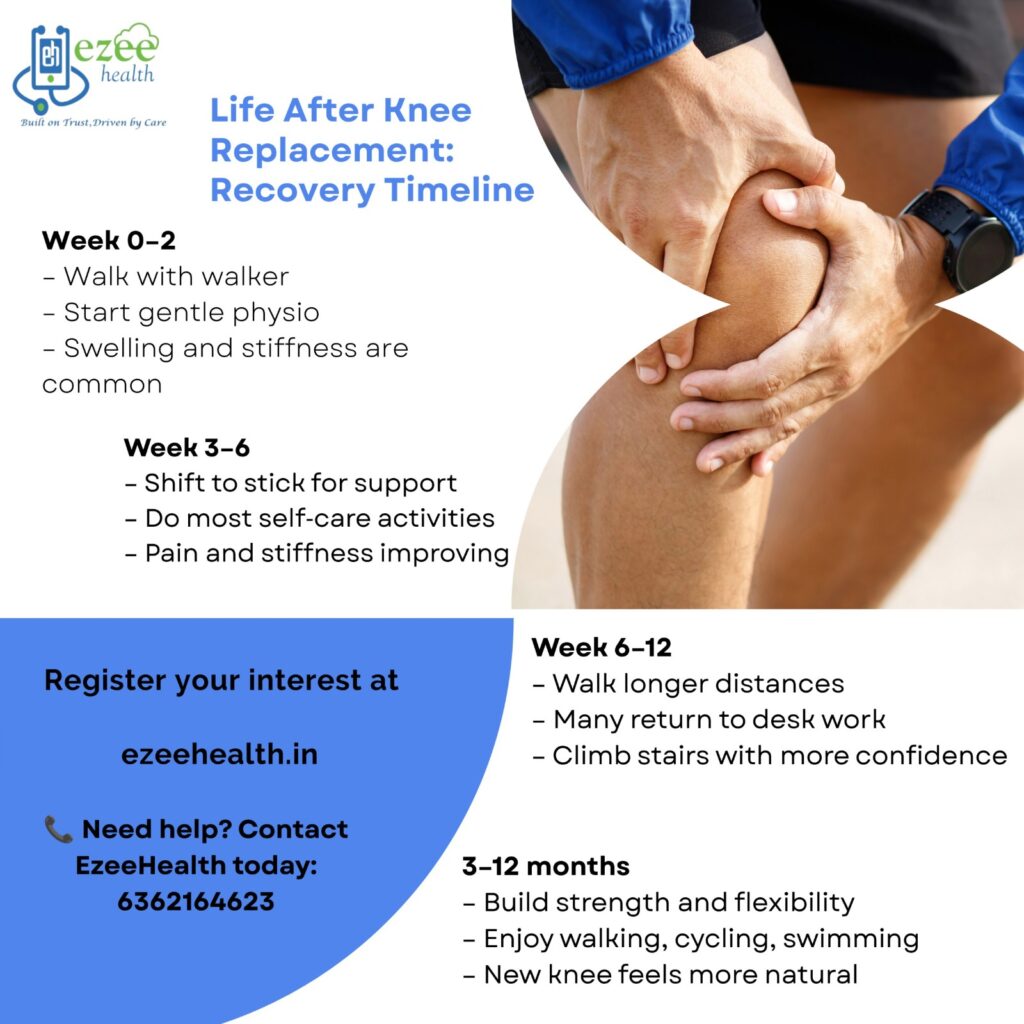
● Week 0–2 (Early phase)
- Walking with a walker or crutches
- Daily physiotherapy to bend and straighten the knee
- Swelling and stiffness are common but gradually improving
● Week 3–6 (Building strength)
- Many patients shift from walker to a cane or single stick
- Able to do most self‑care activities like bathing and dressing
- Pain reduces; focus is on increasing range of motion
● Week 6–12 (Regaining independence)
- Walking longer distances with minimal or no support
- Returning to office work or light duties (depending on job type)
- Climbing stairs with more confidence
● 3–12 months (Long‑term recovery)
- Further strength, flexibility, and confidence improvement
- Most patients return to low‑impact activities like walking, cycling, or swimming
EzeeHealth makes it easier to follow this timeline by syncing your hospital physiotherapy plan with your local physio and doctor, so everyone works towards the same milestones.
3. Walking After Knee Replacement
Walking is one of the most important parts of your recovery.
- In many hospitals, patients are helped to stand and take a few steps with support within 24 hours of surgery.
- You’ll start with a walker, then gradually shift to a stick, and later walk without support as your balance and strength improve.
- The key is regular, short walks throughout the day rather than one long walk that exhausts you.
Through EzeeHealth, your walking goals and progress can be recorded and shared with your hospital surgeon and local physician, so they can adjust your plan if you’re moving too fast or too slowly.
4. Physiotherapy and Exercise Plan
Physiotherapy is the backbone of life after knee replacement. Without it, even a perfectly done surgery may not give the best result.
A typical plan includes:
- Range‑of‑motion exercises to help you bend and straighten the knee
- Strengthening exercises for thigh, hip, and core muscles
- Gait training to help you walk with a natural pattern
- Balance and endurance training in later weeks
Most patients do supervised physiotherapy plus home exercises daily in the early weeks. EzeeHealth allows the hospital physio to share your exercise protocol with your local physiotherapist via the platform or BridgeCare app, reducing confusion and ensuring continuity of care after discharge.
5. Foods to Eat for Faster Recovery
Your new knee needs the right fuel to heal well. While there’s no magic “knee diet,” doctors and nutritionists generally recommend:
- Protein‑rich foods – dal, paneer, curd, eggs, fish, lean meat to help tissue repair
- Iron and vitamin‑rich foods – leafy greens, fruits, nuts, seeds for energy and immunity
- High‑fiber foods – vegetables, whole grains, to prevent constipation from pain medicines
- Plenty of fluids – water, soups, coconut water (unless restricted)
If you have conditions like diabetes, kidney disease, or heart problems, your diet will be customized. EzeeHealth makes it easier for hospital dietitians and local doctors to align on a safe, effective recovery diet for you.
6. Activities to Avoid During Recovery
Protecting your new knee is as important as exercising it. In the first few weeks, you should avoid:
- Sitting with your legs crossed
- Sitting on low stools or the floor
- Twisting or jerking your knee suddenly
- Lifting or carrying heavy weights
Even in the long term, most surgeons advise avoiding high‑impact activities like running, jumping sports, and high‑impact aerobics to protect the implant. Instead, you can enjoy low‑impact options like walking, cycling, swimming, and gentle yoga (within your doctor’s limits).
EzeeHealth helps standardize these instructions so your local doctor and physiotherapist repeat the same safety guidelines you heard in the hospital.
7. When Can You Drive, Travel, and Work Again?
Timelines vary based on your health, type of work, and surgeon’s advice, but general guidance is:
● Driving
- Often possible around 4–6 weeks after surgery, once you have good control, can get in and out of the car comfortably, and are off strong pain medicines. Always take your doctor’s clearance first.
● Traveling
- Short car rides may be possible within a few weeks (with breaks to stretch your leg).
- Longer journeys, especially flights, may need more time and precautions to reduce blood clot risk.
● Work
- Desk jobs: many patients return around 6–8 weeks.
- More physically demanding jobs: may need 3–3.5 months or
EzeeHealth lets your surgeon and local doctor jointly decide and document “fit to drive” or “fit to return to work” timelines, so everyone—including your employer—has clarity.
8. Long‑Term Care of Your New Knee
Your knee implant is designed to last many years, often 15–20 years or more with proper care. To protect it:
- Maintain a healthy weight to avoid extra load on the
- Continue regular low‑impact exercise even after your formal rehab
- Avoid high‑impact sports and heavy lifting that can wear the implant
- Attend scheduled follow‑up visits and get X‑rays as advised to monitor implant
With EzeeHealth, your long‑term follow‑up schedule and reports are not lost over time. Your local doctor and hospital team remain connected, making it easier to catch and manage any issues early.
9. Common Recovery Challenges and Solutions
Even with a good surgery, some patients face challenges such as:
● Swelling and stiffness
- Normal in the first
- Managed with elevation, ice (if recommended), compression, and regular
● Pain or sleep disturbance
- Pain usually improves week by
- Balanced pain medication and relaxation techniques help; sudden worsening should be reported.
● Fear of movement
- Many patients worry they will “damage” the new
- Guided physiotherapy and clear instructions build
● Slow progress
- Some patients take longer due to age, weight, or other health
- EzeeHealth enables your care team to review your progress together and tweak your plan rather than leaving you frustrated and confused.
If any red‑flag symptoms appear—such as fever, severe redness, sudden increase in pain, chest discomfort, or breathlessness—your local doctor can immediately reach out to the hospital team via EzeeHealth for rapid guidance and referral if needed.