The Complete Guide to Knee Replacement Surgery (With a Seamless EzeeHealth Care Journey)
For years, Mr. Sharma thought his knee pain was “just age.”
Slowly, morning walks stopped, climbing stairs became a struggle, and even getting out of bed felt like a daily battle. Every doctor said something different, every hospital gave a new estimate, and his reports were scattered in files and WhatsApp chats. The biggest question remained unanswered:
Do I really need knee replacement surgery now, and where should I go?
This is exactly where EzeeHealth changes the story. Instead of patients and families running from clinic to clinic, EzeeHealth acts as a healthcare coordination & co‑management platform that connects hospitals, specialists, and local doctors on one system. It turns a confusing, stressful knee replacement journey into a guided, transparent pathway—from referral to surgery to follow‑up.
1. What is Knee Replacement Surgery?
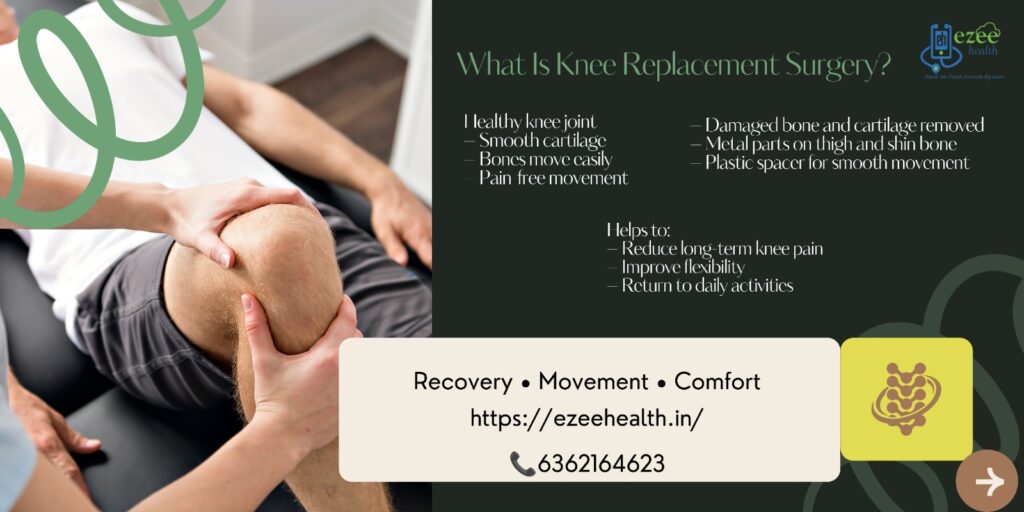
Knee replacement (knee arthroplasty) is a surgical procedure in which the damaged parts of your knee joint are removed and replaced with artificial components made of metal and medical‑grade plastic. The main goals are to:
- Reduce or eliminate chronic knee pain
- Improve movement and flexibility
- Help you return to daily activities such as walking, climbing stairs, working, and traveling
There are two main types:
- Total knee replacement: The entire knee joint surface is
- Partial knee replacement: Only the damaged compartment of the knee is replaced, preserving more natural bone and ligaments.
With EzeeHealth, you are not left alone to make sense of these terms. Your local doctor, orthopedic specialist, and hospital care team can co‑manage your case, explain options in simple language, and plan the right type of surgery for your specific condition.
2. Understanding the Causes of Knee Damage
Knee damage usually builds up over time rather than in a single day. Common causes include:
- Osteoarthritis – the most frequent reason for knee replacement, where the protective cartilage wears away and bones rub against each other, causing pain and stiffness.
- Rheumatoid or inflammatory arthritis – the immune system attacks the joint lining, leading to pain, swelling, and eventual damage.
- Old injuries – untreated ligament tears, fractures, or sports injuries can lead to early

- Excess weight and lifestyle – being overweight and physically inactive puts extra stress on the knees.
- Genetic factors – some people have a family history that predisposes them to early knee problems.
On EzeeHealth, your local doctor and hospital specialists can review your reports together, so the root cause of your knee problem is clearly understood before any big decision like surgery is taken.
3. How to Prevent Knee Damage and Delay Knee Replacement Surgery
Not every patient with knee pain needs immediate surgery. In many cases, knee replacement can be delayed with the right preventive steps and early intervention:
- Maintain a healthy weight to reduce pressure on the
- Do low‑impact exercises such as walking, swimming, or
- Strengthen the muscles around the knee through guided
- Avoid high‑impact activities like jumping or running on hard
- Use braces, orthotic insoles, or walking aids when recommended by your
With EzeeHealth, your prevention plan does not stay on paper. Your physiotherapy updates, pain levels, and progress can be shared through the platform and the BridgeCare app, keeping your local doctor and specialist in sync and allowing them to adjust your plan in real time.
4. Signs You May Need a Knee Replacement
You typically reach the point of knee replacement after several warning signs, such as:
- Severe knee pain that persists even at rest or at night
- Difficulty walking, climbing stairs, or standing up from a chair
- Stiffness and swelling that don’t improve with medicines or physiotherapy
- Visible deformity in the leg (bow‑legs or knock‑knees)
- X‑rays or scans showing advanced joint damage
When these signs appear, EzeeHealth makes it easier for your local doctor to refer you to the right super‑speciality hospital. All your reports, images, and clinical notes can be shared digitally so that the hospital team sees your full picture before you even arrive.
5. Can Knee Replacement Be Avoided?
In early or moderate stages of arthritis, it is often possible to delay surgery with:
- Weight loss and lifestyle modification
- Pain and anti‑inflammatory medicines (under medical supervision)
- Regular physiotherapy and muscle strengthening
- Injections into the joint when appropriate
However, if pain remains severe, your mobility is very limited, and your joint is badly damaged, avoiding surgery may actually prolong suffering and reduce quality of life. With EzeeHealth, you can:
- Take second opinions from other specialists
- Compare different hospitals and treatment approaches
- Make a calm, informed decision instead of a rushed one
6. Treatment Options Before Surgery
Before recommending knee replacement, doctors usually try a combination of non‑surgical treatments:
- Oral medications for pain relief and inflammation control
- Structured physiotherapy to improve flexibility and strength
- Activity modification: avoiding squatting, sitting on the floor, or heavy lifting
- Intra‑articular injections such as hyaluronic acid or other therapies, when suitable
- Assistive devices like walking sticks, walkers, or knee braces
Through EzeeHealth’s platform and the EzeeHealth BridgeCare app, your local doctor can track how well you respond to these treatments, share updates with the hospital specialist, and decide together when it is truly time to move towards surgery.
7. Manual vs Robotic Knee Replacement
Many hospitals now offer both manual and robotic‑assisted knee replacement:
● Manual knee replacement
The surgeon uses traditional instruments, measurements, and their experience to align and fix the implant.
● Robotic‑assisted knee replacement
A robotic system uses 3D imaging to help the surgeon plan and execute very precise bone cuts and implant placement. This can improve accuracy and may support smoother recovery in some patients, though it may also be more expensive and is not necessary in every case.
Using EzeeHealth, you can shortlist hospitals that offer both options, discuss pros and cons with your care team, and choose the approach that suits your condition, city, and budget.
8. Types of Knee Implants Explained
Knee implants are not “one size fits all.” They differ in:
- Material – such as metal‑on‑plastic or ceramic‑coated designs
- Design – cruciate‑retaining, posterior‑stabilized, or gender‑specific implants
- Fixation method – most commonly cemented, with some uncemented options
The best implant for you depends on factors like age, bone quality, weight, activity level, and the surgeon’s expertise. EzeeHealth makes this decision more transparent by ensuring that explanations, implant choices, and reasons are clearly documented and can be reviewed with your local doctor as well.
9. What Happens During Surgery?
On the day of surgery, the typical steps are:
- You are given anesthesia (spinal or general) based on your medical
- The surgeon makes an incision at the front of your knee and exposes the
- Damaged cartilage and a small amount of bone are removed from the thighbone and
- Artificial components are fixed to the bone and sometimes to the back of the
- The surgeon checks alignment and movement, then closes the
The procedure usually takes about 1–2 hours. With EzeeHealth, most of the preparation—pre‑operative tests, anesthetist evaluation, insurance coordination, and early physiotherapy planning—is already aligned between your hospital and local doctor before the surgery date.
10. Risks and Benefits of Knee Replacement
Benefits
- Significant reduction in chronic knee pain
- Improved joint function and mobility
- Better ability to perform daily tasks and enjoy an active lifestyle
- Improved sleep, mood, and overall quality of life
Risks (though uncommon in good centers)
- Infection
- Blood clots
- Implant loosening or wear over time
- Stiffness or ongoing pain
Choosing the right hospital and surgeon, along with strict follow‑up and rehabilitation, can greatly reduce these risks. EzeeHealth supports this by keeping your entire care team connected, ensuring that important instructions, red‑flag symptoms, and follow‑up schedules are not missed.
11. Frequently Asked Questions
Q1. Is knee replacement a very risky surgery?
It is a major procedure, but with modern techniques and experienced surgeons, knee replacement is considered one of the most successful orthopedic surgeries. A well‑coordinated care plan, like the one supported by EzeeHealth, further reduces risks.
Q2. How long does a knee implant last?
Many modern implants can last 15–20 years or more when patients maintain a healthy weight, follow activity guidelines, and attend regular follow‑ups.
Q3. Will I be able to walk normally again?
Most patients start walking with support within 1–2 days after surgery and return to day‑to‑day walking over the next few weeks, guided by physiotherapy and a structured exercise plan.
Q4. How is EzeeHealth different from just choosing a hospital directly?
EzeeHealth is not just a hospital finder. It is a next‑generation co‑management platform that connects super‑speciality hospitals, orthopedic surgeons, local doctors, and physiotherapists. It helps manage your entire journey—from first referral and hospital comparison to surgery, cost clarity, and long‑term follow‑up—so you always feel supported and informed.