'

Health Blogs

Health Blogs

From Confusion to Comfort: How On-Ground Patient Support Transforms Treatment Journeys

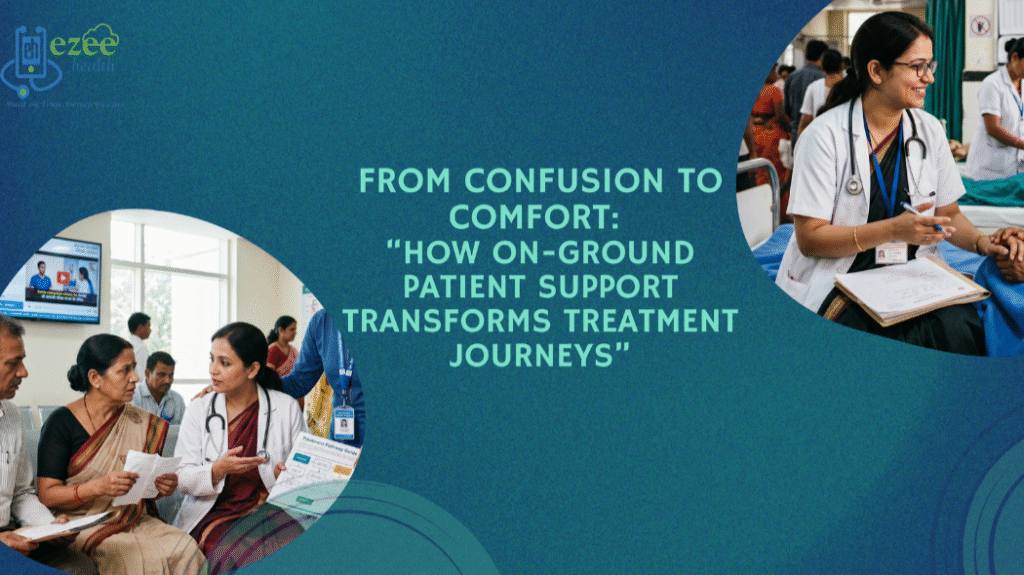
From Confusion to Comfort: How On-Ground Patient Support Transforms Treatment Journeys Ever noticed how treatment doesn’t fail because of medicine but because of confusion, fear, and lack of support? “The doctor said, ‘Your surgery is tomorrow morning’… but in my head, I had only one question – how will I manage all this alone?” Anyone who has gone through a serious health problem knows this feeling. A diagnosis does not only affect the body. It shakes the entire life of a patient and their family including daily routine, money, decisions, emotions, everything. In this chaos, even the best medical plan can fail if there is no one on the ground to guide the patient step by step. This is where on-ground patient support and platforms like EzeeHealth quietly change everything. The “confusion zone” in health care A hospital may have top doctors, advanced technology and great clinical outcomes. But for the patient, the health journey often looks like this: 🔁 Telling the same story again and again to different departments ❓ Not knowing which counter to go to or who to approach 📄 Confusion around which form to fill and which report to carry 🏃♂️ Family members running between billing, pharmacy and wards 💸 Fear of hidden charges and last-minute cost surprises 🧭 No clear idea of what happens next… and after that? This is the “confusion zone” in health care, the gap between what the system knows and what the patient understands. Medical science can decide the treatment. Only strong patient support can make that treatment practically possible in real life. The quiet hero: on ground patient support On-ground support is not just a “nice extra”. It is the invisible backbone of a smooth health journey. Imagine one trusted person a patient coordinator; who: 🧩 Explains the complete process in simple, easy-to-understand language 📤 Ensures reports reach the right doctor at the right time 📅 Aligns tests and appointments to avoid unnecessary visits 💰 Helps families understand cost estimates and plan better 🔄 Follows up after discharge to ensure recovery, medicines, and diet stay on track This is what EzeeHealth brings into the health ecosystem, not just technology, but structured, human support that turns a stressful journey into a guided experience. How EzeeHealth helps hospitals and patients EzeeHealth is a next-generation platform that helps hospitals co-manage and treat patients smoothly, with the patient journey at the centre. In day-to-day health care, this looks like: ●       Transparency in the patient journey Patients and families get clear, timely updates instead of running around for information. They know what stage they are in, what will happen next and whom to contact. ●       Continuous follow-up, not one-time discharge EzeeHealth enables regular check-ins and reminders that keep patients on their treatment path. This supports better long-term health outcomes because patients do not feel abandoned once they leave the hospital. ●       Operational efficiency for hospitals By digitising and coordinating processes, EzeeHealth reduces confusion and manual work for hospital staff. This means less chaos, faster processes and more time for real patient care. ●       Extra value and benefits for patients With curated benefits, upgrades and discounts, EzeeHealth adds real value to the patient’s health journey  not just promises. In simple words: hospitals focus on medical excellence, and EzeeHealth makes sure that excellence actually reaches the patient in an organised, supportive way. A real life style story: from “lost and scared” to “guided and supported” Imagine this. Rohit’s father, 62 years old and diabetic, is diagnosed with a heart condition in a smaller city. The doctor advises treatment in a big-city hospital. Suddenly, the family is inside a completely new health system: ●       New city, new hospital, new rules ●       Different advice from relatives and neighbours ●       Questions about cost, stay, leave from work and long-term care Without support, many families delay treatment or stop halfway because the process feels too heavy. Now, add EzeeHealth into the story: ●       The family doctor uses EzeeHealth to connect them with the right specialty hospital. ●       A patient coordinator explains the full journey – admission, procedure, ICU, recovery, approximate costs and expected timeline – in one conversation. ●       Tests and appointments are pre-planned, reports are shared digitally, and waiting time is reduced. ●       After treatment, EzeeHealth enables regular follow-ups so that medicines, lifestyle changes and check-ups don’t get ignored. The diagnosis is the same, the hospital is the same but the experience of the health journey is completely different. That is the shift from confusion to comfort that on-ground support – powered by EzeeHealth can create. Why this matters today Modern health care is becoming more advanced and more complex. Patients often manage: ●       Several specialists and departments ●       Digital reports, apps and portals ●       Insurance and financial planning ●       Long-term management of chronic diseases The future: a truly guided patient journey The vision is simple and powerful: Any patient diagnosed with a condition that needs specialty medical treatment should have a trustworthy platform to guide them towards the best possible outcome. That is the future EzeeHealth is building: ●       For patients: less fear, more clarity ●       For families: less running around, more emotional space ●       For hospitals: less friction, more meaningful engagement ●       For the health system: better continuity, better outcomes “From confusion to comfort” is not just a tagline. It is the new standard for what a patient journey should feel like and EzeeHealth is working to make that standard real. If you are a doctor who wants to future‑proof your practice—or a patient seeking a more guided, transparent healthcare experience—you can share your details here and our team will connect with you 👇 https://ezeehealth.in/know-more/
Health Blogs

Role of Family Doctor in Specialty Treatment

Role of Family Doctor in Specialty Treatment A 31 year old mother from a small town from Karnataka walked into a big-city hospital for what she was told was a “routine” procedure. By the time she came home, her life and her family’s finances had changed forever. The surgery was technically successful, but a missed detail in her history led to complications, extra days in the ICU, and bills that kept growing long after the discharge summary was signed. At no point in this entire journey did anyone seriously ask: “What does your family doctor think?” This is exactly the kind of ground reality EzeeHealth was built for where families and surgeons make high‑stakes decisions, but the one doctor who knows the patient best is left outside the OT story. When surgeries go wrong, it’s not always about skill Every newspaper carries stories of surgeries gone wrong, mistakes, negligence, pressure, or “system failure”. But if you look closely, many of these cases have a common pattern: ●       The patient moves from clinic to OPD to OT at high speed. ●       Consent becomes a stack of forms, not a real conversation. ●       Co‑morbidities, old reports and allergies don’t travel cleanly between departments. ●       Families feel they are signing for something they don’t fully understand. EzeeHealth steps in before this chaos, at the moment the family doctor first suspects that specialist or surgical care might be needed. From that first suspicion, the platform begins to structure the journey. The family doctor: still the safest starting point For most Indian families, the first call is not to a hospital call centre; it is to “apne doctor”. This doctor: ●       Knows the patient’s long‑term history and risk profile. ●       Understands the family’s financial limits and emotional state. ●       Can honestly say whether surgery is urgent, optional, or whether a second opinion is wise. International evidence shows that when one family physician stays consistently involved, avoidable hospitalisations and emergency visits fall noticeably. Continuity is a safety net, not just a comfort. EzeeHealth is built to keep that safety net firmly in place – not only in the neighbourhood clinic, but all the way into the heart of specialty treatment. The gap: where patients “fall through” Today, families trust their family doctor, specialists and hospitals work in silos with incomplete context and informal WhatsApp‑style referrals, and this “air gap” between clinic and big hospital is exactly what EzeeHealth is built to close. How EzeeHealth changes the story – step by step 1. It starts with the family doctor The journey begins in the GP’s clinic, when the doctor first feels, “Isko ab specialist ko dikhana chahiye.” On EzeeHealth, the family doctor: ●       Records the patient’s history, co‑morbidities and concerns in a structured way. ●       Initiates a digital referral to appropriate specialists and hospitals. ●       Shares questions the family wants answered before agreeing to any procedure. The old man with a weak heart, the 34‑year‑old mother with young kids – neither is thrown directly into a hospital maze. Their own doctor is officially in charge of the first move. 2. Options become visible, not whispered Families usually hear about hospitals and surgeons through friends, relatives or “someone known inside”. EzeeHealth replaces this whisper network with a transparent view of: ●       Suitable specialists, ●       Possible hospitals, ●       Likely procedures and package ranges, ●       Expected length of stay and follow‑up needs. The family can sit with their GP, see these options on the platform, and decide calmly – instead of running from reception desk to billing counter in panic. 3. The specialist sees a complete picture When the patient reaches the specialist: ●       The EzeeHealth referral already carries their detailed history, not just a one‑line note. ●       The surgeon or super‑specialist can focus on high‑quality decision‑making, not reconstructing basics in a rushed OPD. ●       Misunderstandings about past illnesses, medications or allergies are far less likely. EzeeHealth doesn’t replace the specialist’s judgment; it strengthens it with context. 4. Co‑management doesn’t stop at discharge Once the surgery or specialty procedure is done, most patients are discharged with a few instructions and a follow‑up date. The family doctor often gets a partial or late update – if at all. With EzeeHealth- ●       The discharge summary, operative details and follow‑up plan are visible to the GP on the same platform. ●       The family can go back to their familiar clinic, confident that their doctor knows exactly what was done inside the big hospital. ●       Long‑term management – medicines, lifestyle, rehab – is owned again by the family doctor, who now has complete information. The story that began in the clinic comes back to the clinic – without broken links. From headlines to hope Every time a headline screams “routine surgery goes wrong”, we ask who is to blame. A better question is: What kind of system would have made that journey safer, clearer and more coordinated – from the very first visit? EzeeHealth is one attempt at that system. It keeps the family doctor in the frame from start to finish, gives specialists complete context, and lets hospitals work with structured, GP‑backed referrals. For the old man, for the 34‑year‑old woman, for any family staring at a big medical decision – that single change can be the difference between a nightmare and a navigable journey. If you are a doctor who wants to future‑proof your practice or a patient seeking a more guided, transparent healthcare experience—you can share your details here and our team will connect with you 👇 https://ezeehealth.in/know-more/
Health Blogs

EzeeHealth Comanagement platform as the next leap in Indian healthcare

EzeeHealth Comanagement platform as the next leap in Indian healthcare When an Indian doctor says, “You need surgery,” EzeeHealth believes your primary doctor should not disappear from the story; they should become your co-pilot. In India, a surgery isn’t just a procedure. It is the moment a family’s savings, sleep, and sense of control all go under anaesthesia and too often, their primary doctor goes missing from the frame. One conversation with the doctor suddenly becomes ten: second opinions, package comparisons, insurance queries, room categories, and late-night Google searches, with no single trusted guide holding it all together. EzeeHealth was built with this purpose that the family doctor who knows the patient best quietly exits the picture just when tertiary care and big hospital decisions begin. The reality behind one sentence: “You need surgery” ●       India still spends far less on health than many countries roughly 80 USD per person per year, compared to a global average of over 1,300 USD and close to 6,000 USD per person in many OECD nations. ●       Households here continue to pay close to half of all health costs from their own pockets, almost double the global out‑of‑pocket average of around 20%. ●       Hospital beds and specialised capacity are limited around 1.3 beds per 1,000 people versus 3–8 per 1,000 in many developed health systems making each “which hospital?” decision a high‑stakes choice. The missing piece: co management, not just referral EzeeHealth reimagines this script. If a serious diagnosis is made. The family doctor does not disappear after writing the referral. Instead: ●       The primary doctor and the super‑specialist both log into EzeeHealth’s co‑management platform. ●       They review the case together, see the same reports and investigations, and document options in one place: which procedure, which hospital, what approximate cost range, what key risks to discuss with the family. ●       As the patient moves from clinic to admission, surgery, discharge, and follow‑up, both doctors receive real‑time updates through EzeeHealth. When the family has doubts, they no longer have to choose between “our doctor” and “the hospital doctor”. Through EzeeHealth, they are finally on the same side of the table. What EzeeHealth actually does – with the primary doctor in the spotlight From day one, EzeeHealth has been engineered around the primary doctor + specialist + hospital triangle, not just the hospital alone. At its core, the platform does four things: Connects hospitals and doctors, instead of isolating them Keeps care transparent for doctors and families Builds continuous follow‑up, not one‑time episodes In a country where out‑of‑pocket spending is still almost double the global average, EzeeHealth uses its network to negotiate upgrades and discounts within an ethical, transparent framework. Families get better value on procedures and stay without last‑minute bargaining at the billing counter, and primary doctors can recommend hospitals knowing there is a structured ecosystem behind the scenes. In simple words: EzeeHealth is a co‑management bridge between General Physicians and super‑specialists, built for Indian reality — so that when a patient needs tertiary care, they get the best possible value and price without losing the one doctor they trust the most. In a country where public spending is low, out‑of‑pocket burden is high, and trust is deeply personal rather than institutional, we simply cannot afford workflows in which the most trusted person — the primary doctor — exits the story at the critical moment. EzeeHealth is building a future where “You need surgery” does not have to mean “You are on your own.” It can mean: ●       Your primary doctor stays with you, digitally and emotionally. ●       Your options are transparent, not mysterious. ●       Your journey is coordinated across hospitals, not left to you to manage. So that your family can finally focus on healing while EzeeHealth quietly keeps your doctor, your specialist, and your hospital on the same page. If you are a doctor looking to future-proof your practice, or a patient seeking a more guided and transparent healthcare experience, you can share your details through the link below. Our team will get in touch with you https://ezeehealth.in/know-more/

Health Blogs

Navigating the AI revolution: the future for general practitioners in India

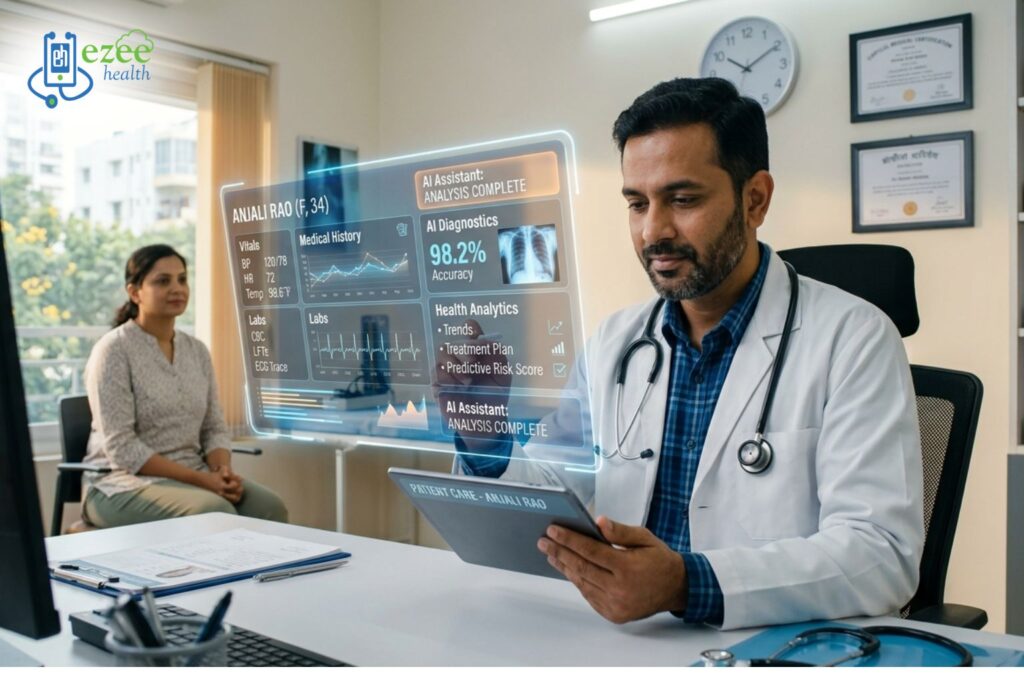
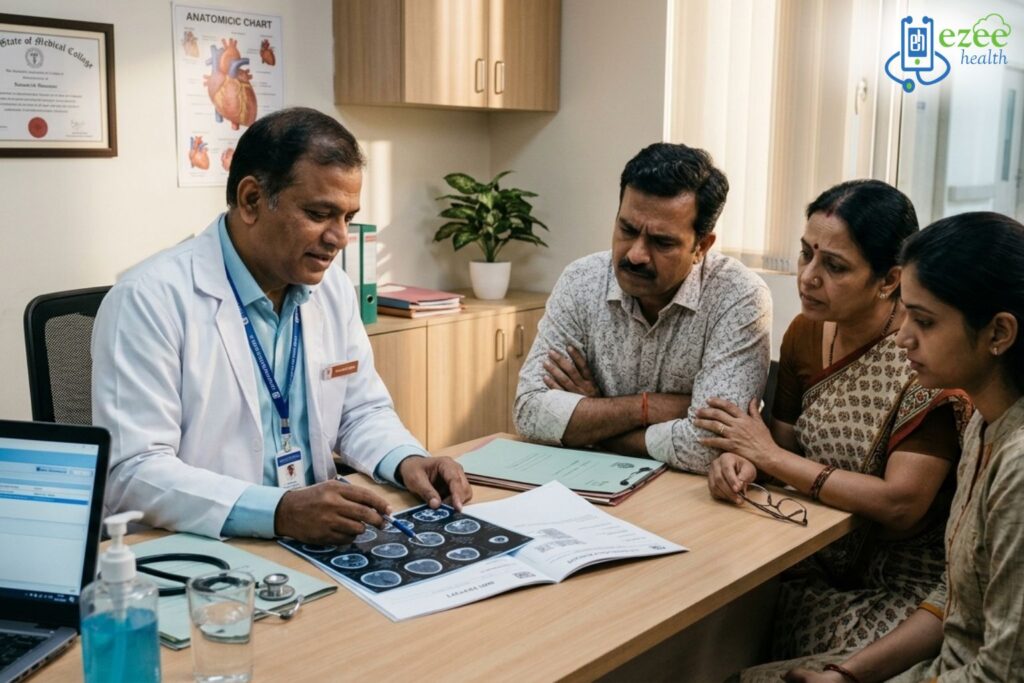
Navigating the AI revolution: the future for general practitioners in India For a family doctor in India, the clinic has started to look very different from a decade ago. AI‑enabled teleconsultations, digital reports, automated summaries and remote monitoring tools are slowly entering everyday practice and with them comes a big question: will AI replace general practitioners, or quietly become their strongest ally? Globally, AI in healthcare has grown from a niche experiment to a multi‑billion‑dollar industry, projected to continue growing at over 30 percent annually this decade. These tools can read scans, support diagnosis, predict risk, automate documentation and even assist in treatment planning. Primary care, which delivers up to 90 percent of essential health services worldwide, is now seen as the natural front line for this transformation. In this changing landscape, the most critical question is: who will connect all these technologies so that the family doctor remains at the Centre, not pushed to the sidelines? India’s general practitioners at a turning point India has moved from “catching up” to becoming one of the fastest adopters of AI in clinical practice. Recent reports show that AI adoption among Indian clinicians has jumped from about 12 percent to over 40 percent in just one year, outpacing many high income countries. This is exactly the gap platforms like EzeeHealth aim to close by using AI and digital infrastructure to connect doctors, hospitals and specialists into a single, coordinated care pathway, so the GP becomes a continuous treatment partner rather than just the first touchpoint. According to a report by MarketsandMarkets, the global edge computing market is expected to grow from $168 billion in 2025 to nearly $249 billion by 2030, driven by the rapid adoption of AI, IoT, and 5G technologies. This growth highlights how real-time data processing at the edge is becoming a critical pillar of the digital economy. How EzeeHealth is empowering family doctors in the AI era EzeeHealth is designed to bridge the gap between standalone AI tools and real‑world clinical practice. Instead of treating AI as a gadget, EzeeHealth uses technology to connect what truly matters: family doctors, hospitals and super‑specialists on a single, coordinated digital backbone. EzeeHealth simplifies the entire treatment journey by: ●       Providing a transparent patient pathway, with real‑time updates and clear communication for both doctors and patients. ●       Enabling continuous follow‑up even after hospital transfer or discharge, so the family doctor remains in the loop and long‑term outcomes improve. Post‑discharge medications, follow‑up visits, investigations and lifestyle interventions are structured and routed back to the GP through EzeeHealth, turning continuity of care into a practical reality. ●       Digitizing referrals, coordination and financial settlements, which reduces administrative burden and speeds up workflows for hospitals and clinics. This cuts down the back‑and‑forth calls between OPDs, hospital desks and insurance/TPA teams, allowing GPs to spend more time on clinical decision‑making rather than chasing forms and follow‑ups. ●       Curating patient benefits such as hospital upgrades, discounts and enhanced treatment support, making high‑quality care more accessible. When patients receive clearer options, better value and cost transparency, it becomes easier for GPs to recommend the best possible care, knowing the platform is supporting their advice both financially and logistically. For hospitals, EzeeHealth offers structured referrals, better tracking and seamless coordination with specialists. For patients, it transforms a confusing, fragmented process into a guided journey that helps them find the right specialist, understand their options and experience coordinated, compassionate care with their trusted family doctor always in the loop. For GPs, it is a way to make AI part of their team rather than something they need to compete with. If you are a doctor who wants to future‑proof your practice or a patient seeking a more guided, transparent healthcare experience you can share your details here and our team will connect with you 👇 https://ezeehealth.in/know-more/
Health Blogs

In India, “You need surgery” is rarely just a medical line, it is often the moment a family’s life, savings, and sense of control go into ICU.

In India, “You need surgery” is rarely just a medical line, it is often the moment a family’s life, savings, and sense of control go into ICU. Why we Built EzeeHealth In our last post, we spoke about what really happens after a “you need surgery” diagnosis, the confusion between doctors’ opinions, hospital packages, and Google searches. Over months of observing patients and families, two truths became impossible to ignore: The one person patients trust the most,  their family doctor quietly exits the frame the moment tertiary care begins. The patient’s journey through specialty hospitals is so fragmented and admin-heavy that even the bravest families feel lost, exhausted, and financially exposed. EzeeHealth was born from this gap. Truth 1: The family doctor should never leave the story Ask any Indian patient: “Whom do you ask first?” Most will still say, “Our family doctor.” Yet once a serious diagnosis appears, the script changes: 🔍The patient is referred to a super-specialist or tertiary hospital. 🔍Clinical decisions, estimates, and consent forms move into a world where the primary physician has almost no visibility. 🔍The person who knows the patient’s history, fears, and context becomes a spectator instead of a guide. We don’t believe this is how it should be. At EzeeHealth, we are building a co-management platform because we believe: ✔️The General Physician and super-specialist review the case together on a shared digital platform. ✔️Treatment options, risks, and costs are discussed in a structured way instead of scattered WhatsApp messages. ✔️ The primary physician continues to receive updates and can guide the family at every crossroad admission, procedure, discharge, and follow-up. In simple words: We want every patient to feel, “My doctor is with me at every step.” Truth 2: Patients need a “friend in the system”, not just a file number India does not just have a medical problem; it has an administrative pain problem. 📈Around 39–40% of total health expenditure in India is still out-of-pocket, making every surgery decision a financial tightrope for families. 📈Catastrophic health spending (health costs >10% of household income) affects tens of millions of households and pushes roughly 50–90 million people towards poverty each year. 📈Studies and second-opinion platforms have repeatedly shown a worrying rate of disagreement on surgery recommendations, with some analyses flagging a high proportion of potentially unnecessary procedures. Behind every statistic is a real story of patients delaying needed surgery, caregivers drowning in paperwork, and families realising too late that a better-aligned hospital or treatment option existed. This is why EzeeHealth created a patient concierge service not as a luxury add-on, but as a basic human need. Our concierge is designed to be that “friend in need” who: 🤝Helps the patient navigate from diagnosis to discharge: appointments, documentation, estimates, referrals. 🤝Minimizes administrative trauma so that the family can focus on recovery, not paperwork. 🤝Uses our network of trusted specialty hospitals and doctors to find the right fit — clinically, ethically, and financially. 🤝Works with our digital platform so every update is transparent and traceable, not lost in phone calls and verbal assurances. What Ezee Health really is (beyond the tech jargon) A co-management digital platform between General Physician and super-specialist that helps a patient in need of tertiary care get the best value and price for his/her procedure or surgery. Under the hood, this means: 📌Connected hospitals: Departments and partner hospitals stay coordinated so the patient doesn’t pay the price of miscommunication. 📌Transparent care: Real-time updates and tracking reduce guesswork and anxiety for families. 📌Continuous follow-up: Patients don’t “fall off the radar” after discharge; their primary doctor remains involved with digital support. 📌Curated benefits: Upgrades and discounts negotiated ethically within the ecosystem, not through last-minute chaos. We did not build EzeeHealth for hospitals alone. We built it so that hospitals, doctors, and patients can finally be on the same side of the table. It keeps the family doctor involved, makes hospital journeys transparent, cuts admin and financial stress, and treats patients not as “cases” but as humans making one of the hardest decisions of their life. If you are a: ●      General Physician who wants to stay involved even after referring your patient. ●      Super-specialist or hospital leader who believes in ethical, transparent, co-managed care. ●      Patient or caregiver who has lived through a confusing, stressful surgery journey. Feel Free to Join Our remarkable Journey with Ezeehealth and get associated with us, Kindly fill your details. Please Click the Below Link :-https://forms.zohopublic.in/ezeehealth7461/form/KnowMoreaboutEzeeHealth/formperma/uIIKlEU3HI_PMz3XzhXjBYkgW_Awi65Pu0qdwmfKsaQ DM us to explore more with EzeeHealth, we are here to Guide your Patient’s providing best service with our partnered Tertiary Care Across Karnataka. Mail us for More Information support@ezeehealth.in

Health Blogs

Using AI in primary healthcare – empowering local doctors/physicians with AI tools to improve better diagnosis and prognosis at the patient’s location

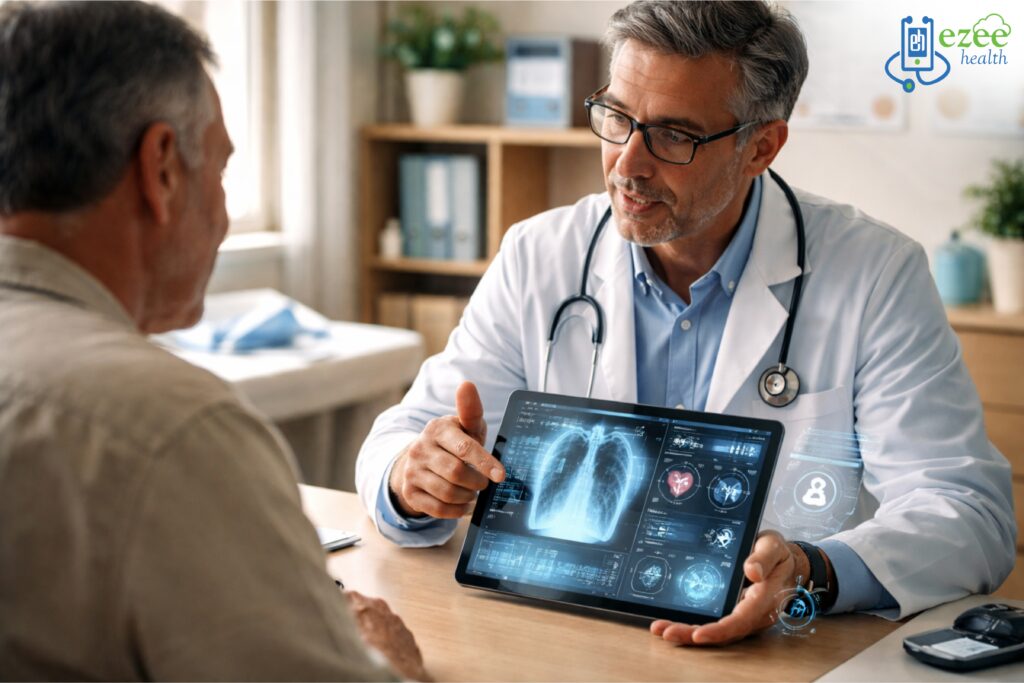
Using AI in primary healthcare – empowering local doctors/physicians with AI tools to improve better diagnosis and prognosis at the patient’s location Today in India, the first point of contact for most patients is not a specialist, but the local doctor – the Neighbourhood clinic, a small-town physician, or the doctor sitting at a Primary Health Centre (PHC) in your locality. This is exactly where the most critical decisions are made: “Is this just a simple fever or something serious?”, “Should I treat here or refer immediately?” Heard it right? The challenge is that these doctors often work with limited diagnostics, limited time, and little direct specialist support but the expectations from patients and families are extremely high. This is where AI-enabled tools are quietly revolutionizing primary healthcare: making diagnosis more accurate, prognosis more data-driven, and clinical decisions more confident – right at the patient’s location. Ezeehealth’s vision is simple: AI should not replace doctors, it should reinforce them so that every local doctor has “supercharged clinical judgement” without needing to send every case to a big city hospital. 𝐖𝐡𝐲 𝐢𝐬 𝐀𝐈 𝐢𝐧 𝐩𝐫𝐢𝐦𝐚𝐫𝐲 𝐡𝐞𝐚𝐥𝐭𝐡𝐜𝐚𝐫𝐞 𝐢𝐬 𝐧𝐨 𝐥𝐨𝐧𝐠𝐞𝐫 𝐨𝐩𝐭𝐢𝐨𝐧𝐚𝐥? 𝐋𝐞𝐭’𝐬 𝐜𝐫𝐚𝐜𝐤 𝐢𝐭. Across global healthcare systems, one trend is very clear: By 2030, there is an expected shortfall of around 18 million healthcare professionals worldwide, including roughly 5 million doctors. Primary care is being asked to manage more patients, more complex chronic diseases, and rising expectations often with the same or even fewer resources. In this reality, AI is not a fancy add‑on but a force multiplier that analyses symptoms, vitals, and history for risk stratification, interprets X-rays and fundus scans quickly and accurately, and predicts patient trajectories early enough for timely intervention. In simpler terms: When a doctor is asking, “Should I admit this patient now or is home monitoring safe?”, AI acts like a second brain that supports that decision. 𝐇𝐨𝐰 𝐀𝐈 𝐩𝐫𝐚𝐜𝐭𝐢𝐜𝐚𝐥𝐥𝐲 𝐞𝐦𝐩𝐨𝐰𝐞𝐫𝐬 𝐥𝐨𝐜𝐚𝐥 𝐝𝐨𝐜𝐭𝐨𝐫𝐬 𝟏. 𝐁𝐞𝐭𝐭𝐞𝐫 𝐝𝐢𝐚𝐠𝐧𝐨𝐬𝐢𝐬 𝐚𝐭 𝐭𝐡𝐞 𝐟𝐢𝐫𝐬𝐭 𝐭𝐨𝐮𝐜𝐡𝐩𝐨𝐢𝐧𝐭 Research shows that AI algorithms in image-based diagnosis can often achieve specialist-level performance detecting pneumonia from chest X-rays, classifying skin lesions, or spotting diabetic retinopathy. In a primary care setting, this translates into: ●      Taking a retinal image using a smartphone or basic device and screening for diabetic retinopathy with AI. ●      Using lung sounds and vitals to flag risk of tuberculosis or sepsis. ●      Combining ECG data with heart sounds to detect early cardiac issues even before obvious symptoms appear. The earlier the disease is detected, the fewer the complications, the lower the cost, and the better the quality of life and all of this can start from the local clinic itself. 𝟐. 𝐒𝐦𝐚𝐫𝐭𝐞𝐫 𝐩𝐫𝐨𝐠𝐧𝐨𝐬𝐢𝐬 𝐚𝐧𝐝 𝐫𝐢𝐬𝐤 𝐩𝐫𝐞𝐝𝐢𝐜𝐭𝐢𝐨𝐧 After diagnosis, the next big question is always: “What happens next? Here, AI can: ●      Combine multi-year medical records, vitals, lab results, and lifestyle data to predict disease progression. ●      Flag high-risk cohorts – for example, which diabetic patients are at higher risk of retinopathy, or which cardiac patients have a higher chance of readmission. ●      Give the doctor clear signals on which patients need aggressive follow-up and which can be safely managed through remote monitoring. This leads to: ●      Fewer unnecessary referrals. ●      Deeper focus on genuinely high-risk patients. ●      Smarter utilization of scarce resources in resource-limited settings. 𝟑. 𝐑𝐞𝐝𝐮𝐜𝐢𝐧𝐠 𝐛𝐮𝐫𝐝𝐞𝐧, 𝐢𝐧𝐜𝐫𝐞𝐚𝐬𝐢𝐧𝐠 𝐫𝐞𝐚𝐥 “𝐟𝐚𝐜𝐞 𝐭𝐢𝐦𝐞” 𝐰𝐢𝐭𝐡 𝐩𝐚𝐭𝐢𝐞𝐧𝐭𝐬 AI is not just about diagnosis and prognosis – it can also take over many repetitive, low-value tasks: ●      Auto-generating clinical notes and documentation. ●      Handling basic triage questions through AI-based chatbots. ●      Automating follow-up reminders, lifestyle nudges, and remote vital monitoring. The result: local doctors spend less time glued to screens and more time in real conversation with patients – preserving the human touch that makes healthcare truly humane. 𝐄𝐳𝐞𝐞𝐡𝐞𝐚𝐥𝐭𝐡’𝐬 𝐯𝐢𝐬𝐢𝐨𝐧: 𝐀𝐈 𝐭𝐡𝐚𝐭 𝐭𝐫𝐚𝐯𝐞𝐥𝐬 𝐭𝐨 𝐭𝐡𝐞 𝐩𝐚𝐭𝐢𝐞𝐧𝐭, 𝐧𝐨𝐭 𝐣𝐮𝐬𝐭 𝐭𝐡𝐞 𝐡𝐨𝐬𝐩𝐢𝐭𝐚𝐥 Most advanced tools have traditionally stayed locked inside tertiary care hospitals. Ezeehealth is building in the opposite direction: For Ezeehealth, AI means: ●      Human-centred design -tools that integrate into existing clinical workflows instead of disrupting them. ●      A doctor-first approach – AI can suggest, but the final decision always rests with the physician. ●      Deep trust with data privacy, patient safety, and regulatory compliance is treated as non-negotiable. The most powerful asset in healthcare is still the doctor’s empathy, experience, and understanding of context. In this partnership: ●      AI handles pattern recognition, speed, and heavy data crunching. ●      The doctor gets a more complete view of the patient – enabling them to explain clearly, discuss options, and involve the patient in shared decision-making. This pairing leads to: ●      Patients feeling, “My doctor took me seriously, looked at the data, and explained everything clearly.” ●      Doctors feeling, “I now have tools that were once available only in large corporate hospitals.” This is the core belief at Ezeehealth: AI-intelligent systems plus human-intelligent doctors together create genuinely better care. Some numbers that signal where the world is heading ●      The AI in healthcare market was around 11 billion USD in 2021 and is projected to grow to roughly 187 billion USD by 2030 – showing the pace of adoption. ●      A 2025 survey indicates that about two-thirds of physicians already use some form of health-AI tools, and a significant majority believe AI can have a positive impact on patient care. ●      Imaging-based AI tools have demonstrated specialist-comparable accuracy in pathology, radiology, ophthalmology, and cardiology across multiple studies. If you want AI-powered data support to sharpen your clinical judgement, make diagnosis and prognosis more objective and efficient, and still keep human, doctor-led care at the Centre, then Ezeehealth is built for you. We are currently collaborating with selected local doctors, clinic owners, and primary care physicians to pilot AI-enabled primary care pathways – especially in areas where specialist access is limited. Fill out this form, and our team will connect with you for a detailed walkthrough: https://forms.zohopublic.in/ezeehealth7461/form/KnowMoreaboutEzeeHealth/formperma/uIIKlEU3HI_PMz3XzhXjBYkgW_Awi65Pu0qdwmfKsaQ

Health Blogs

Primary Care: The First Line Against Breast Cancer

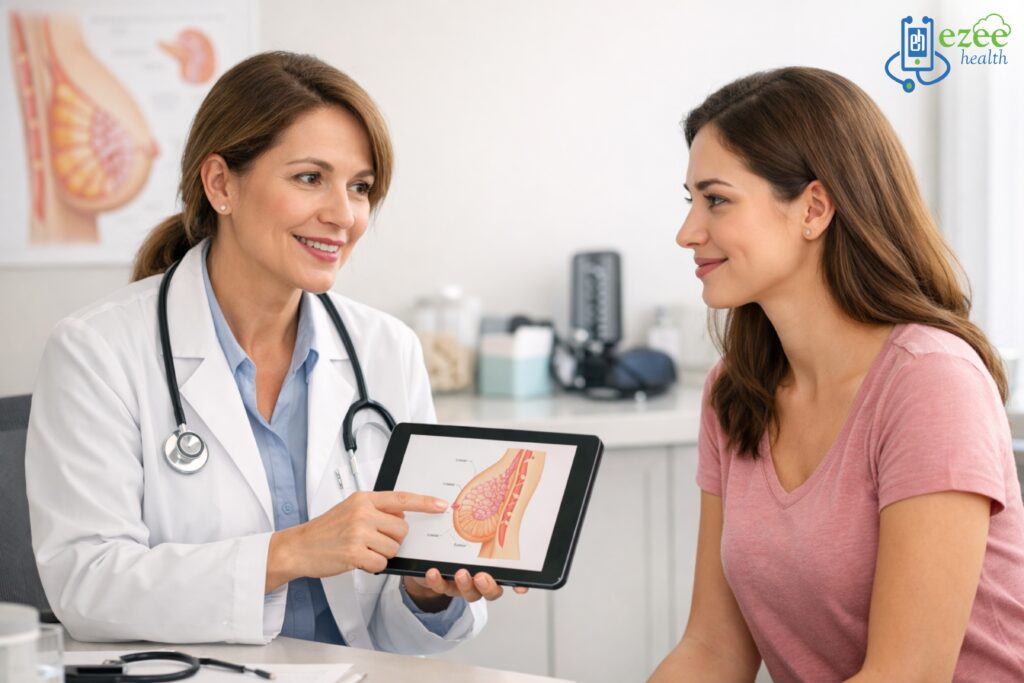
Primary Care: The First Line Against Breast Cancer Breast cancer doesn’t start at the cancer center. It starts in a clinic, with a hurried consultation, a missed mammogram reminder, or a family history that no one has time to capture. That’s exactly where the primary physician and EzeeHealth enter the frame. The 99% vs 31% reality When breast cancer is found early, while still confined to the breast, the five‑year survival rate is close to 99%. Once it has spread to distant organs, that number drops to nearly 31%. In many high‑income countries, overall five‑year survival for breast cancer now crosses 90%. In India, it hovers around the mid‑60s, and in parts of Africa it can be as low as 40%. The difference isn’t biology; it’s timing who gets screened, who gets flagged, and who gets followed up. Global initiatives like the WHO’s Global Breast Cancer Initiative are pushing countries to reduce mortality by 2.5% per year by focusing on early detection, timely diagnosis, and better treatment access. For India, where women often present later and health systems are fragmented, the frontline is not a fancy tertiary hospital. It’s the primary physician and the digital tools that support them. The primary physician: first responder Most women will speak to a primary doctor about vague aches, fatigue, menstrual issues, or diabetes long before they ever meet an oncologist. That first contact is where early detection really lives. A good primary physician can: ●      Take a proper risk history: family history of breast/ovarian cancer, early/late menarche, childbirth patterns, hormone use, past breast biopsies.   ●      Translate guidelines into real life: discussing mammograms from age 40 onward (or earlier in high‑risk women), and not postponing “routine” screening year after year.   ●      Respecting red flags: a new lump, nipple discharge, skin dimpling, local redness, or unexplained persistent back/shoulder pain in a woman over 35 is not “let’s wait and see” it’s “let’s imagine and refer.”   ●      Guide the journey: from the first abnormal report to biopsy, surgery, systemic treatment and survivorship, primary care remains the one constant who understands the whole person, not just the tumor.   Data from large cohorts show that women who have regular contact with primary care are more likely to get mammograms on time, less likely to present in late stages, and have better survival. The science is clear: early detection saves lives. The system question is who makes early detection actually happen? Where EzeeHealth makes primary care sharper Now imagine the same overworked GP, but with an intelligent layer under every appointment. That’s where EzeeHealth comes in not as another AI enabled healthcare tech platform , but as the operating system for early detection in primary care. Here’s how: ● Risk on autopilot Every new patient or annual visit can start with a smart pre‑consult form: family history, menstrual and reproductive history, lifestyle risks. The platform scores risk in the background and quietly flags women who need earlier or more frequent screening.   ● Screening that doesn’t depend on memory Instead of expecting doctors to remember every guideline, EzeeHealth builds them into the workflow. Women 40+ can be automatically enrolled into a mammography reminder journey annual or biennial depending on your protocol. Missed appointments trigger follow‑ups instead of getting lost in a busy reception desk diary.   ● Red‑flag prompts inside the consultation When the physician documents “nipple discharge”, “breast pain”, “new lump” or certain skin changes, the system can nudge: “Consider diagnostic mammogram/ultrasound + priority referral.” This doesn’t replace clinical judgement, it protects it from fatigue and forgetfulness.   ● No abnormal report left behind An abnormal mammogram should never sit in an inbox. The platform can create a task: call a patient, explain a report, schedule further imaging or biopsy, confirm that the specialist appointment is booked. The loop is closed only when each step is done.   ● Equity by design For India especially, the women who most need early detection are often those with the weakest access rural, low‑income, or juggling multiple chronic illnesses. EzeeHealth can show which women in your practice are overdue for screening by age, pin code, and risk, helping you reach the right people first, not just the ones who shout the loudest. In short, primary physicians provide clinical judgment and trust; EzeeHealth provides the rails so that no woman is missed simply because the system is chaotic. A quiet revolution in outcomes If you zoom out, the story is simple. High‑income countries didn’t slash breast cancer mortality by magic. They did it by making an early detection routine: structured programs, reminders, tracking, and accountability. India and many other regions are now at that inflection point. The medicine is largely the same. What’s missing is consistency. Primary physicians are already the moral center of this change. Their decisions determine whether a woman’s cancer is found at a 99% survival stage or a 31% survival stage. A platform like EzeeHealth simply makes those good decisions repeatable across thousands of women, not just a lucky few. If you want to explore how many women in your network may be overdue for screening—and how quickly you can close that gap, share your details in the form and we’ll walk you through it. If you’re a doctor and would like to explore how this could work in your practice, we’d love to connect. Fill out this short form and our team will reach out to you for a personalized, step‑by‑step walkthrough: https://forms.zohopublic.in/ezeehealth7461/form/InteractionFormwithEzeeHealthCoFounders/formperma/pHh5jrH142aocsyX8y4z7K5MyrZjhy4GSX9i1symE3U

Health Blogs

India’s Health Revolution Begins at Primary Health Centres

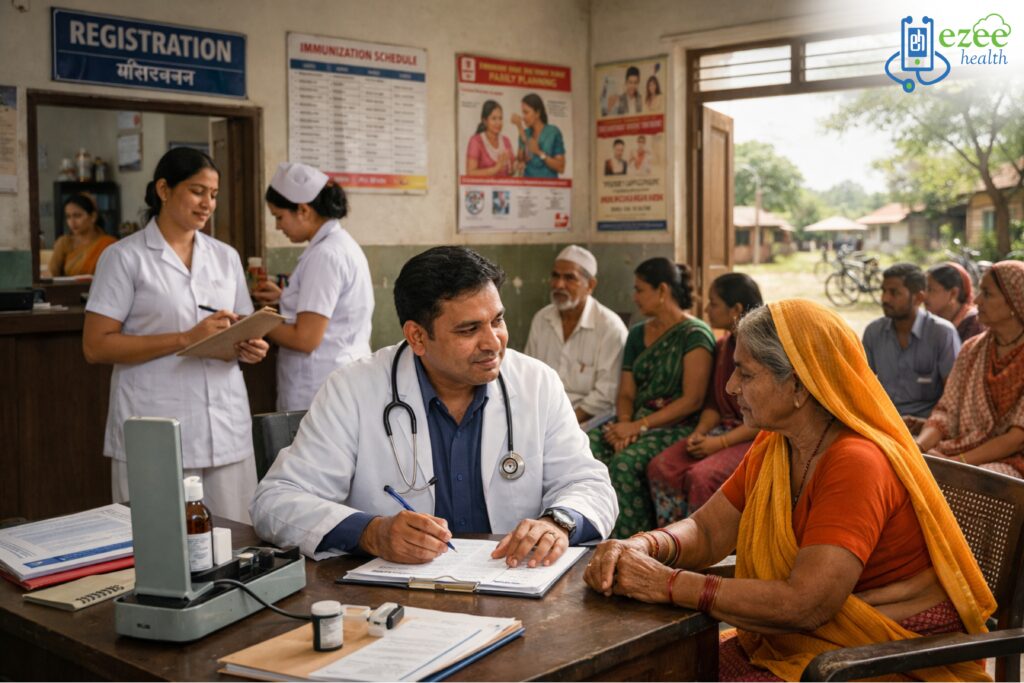
India’s Health Revolution Begins at Primary Health Centres India’s healthcare won’t change in ICUs first, it will change in its Primary Health Centres. The Reality: A Vast Network, Barely Used India has built an elaborate network of almost 200,000 Government Primary Health Care Facilities across rural and urban areas. In theory, this should mean that affordable, accessible care is always close to where people live. In reality, these facilities are massively underutilised. Excluding maternal and child health services, only 11.5% of rural and 3.9% of urban people who needed care actually used this public primary care network in 2013–14. That means nearly 9 out of 10 people are going elsewhere either rushing to higher-level government hospitals or straight to private providers. At the same time, non-communicable diseases (NCDs) like heart disease, diabetes, cancers, and chronic respiratory illnesses now account for around 60–65% of all deaths in India, up from under 40% in 1990. These are conditions that need early detection, long-term follow-up, and strong primary care – exactly what PHCs were meant to deliver. The Cost of Weak Primary Care When PHCs don’t work the way they should, people pay the price – literally. Out-of-pocket expenditure still contributes close to 47% of India’s total health spending, even after years of schemes and reforms. For many households, health expenses crossing just 10% of their budget become “catastrophic”, pushing them into debt or forcing them to cut on essentials. Think about a daily wage worker who ignores early symptoms of diabetes or eye problems because the local PHC feels unreliable or inconsistent. By the time he reaches a big hospital, his condition is advanced, treatment is more complex, and he’s already lost weeks of income. One missed PHC visit can trigger a chain of medical and financial stress that affects the entire family. Why Empowering Government PHCs Is Non Negotiable? Empowering PHCs isn’t just a nice idea – it’s the most efficient and humane way to fix the system. Strong PHCs can: ●      Handle a majority of common illnesses, basic emergencies, chronic disease screening and follow-up at the local level. ●      Reduce unnecessary load on district and tertiary hospitals so they can focus on complex cases. ●      Cut out of pocket spending by ensuring free or low-cost consultations, essential drugs, and basic diagnostics closer to home. ●      Build trust and continuity, especially for NCDs that need long-term, relationship-based care. ●      In simple terms: if we get primary care right, everything else in the system starts working better. Where Digital Platforms Like EzeeHealth Come In But bricks and mortar alone are not enough. To truly empower PHCs, we also need digital coordination that keeps everyone patient, PHC, specialist, and hospital on the same page. This is where platforms like EzeeHealth can play a pivotal role: For patients, EzeeHealth acts like a digital companion that co‑manages their journey from first consultation to surgery to recovery. Real‑time updates, structured follow-ups, and curated benefits (like discounts or service upgrades) turn a confusing health experience into a guided, transparent path. For doctors and hospitals, it digitizes manual processes, reduces errors, and improves coordination between departments. When a PHC refers a patient onward, EzeeHealth can help ensure that information doesn’t get lost and that the patient isn’t left to navigate alone. With a strong presence in Ophthalmology and a network of trusted hospitals and doctors in Bangalore, EzeeHealth is already proving how digital tools can make care smoother, smarter, and more patient-centric – especially for conditions where early intervention is critical. Now imagine the impact if empowered PHCs become the clinical starting point, and EzeeHealth becomes the digital backbone that connects every next step. The future of Indian healthcare will be built on two layers working together: The ground layer: Government Primary Health Centres that are staffed, stocked, trusted, and able to handle most health needs early. The cloud layer: intelligent platforms like EzeeHealth that track, coordinate, and support the entire care journey across PHCs, specialists, and hospitals. When the first door to care is strong and every step after that is digitally co‑managed – health stops being a gamble and becomes a predictable, humane experience. Empowering Government Primary Health Centres, supported by next‑generation platforms like EzeeHealth, is not just about improving a facility. It’s about protecting families from preventable disease, financial shocks, and invisible gaps in the system. If you are a doctor and would like to explore how this could work in your practice, you can fill out a short form and the team will reach out with a personalized, step‑by‑step walkthrough https://ezeehealth.in/know-more/
Health Blogs

The crucial role of paramedics in delivering healthcare to a larger Indian population

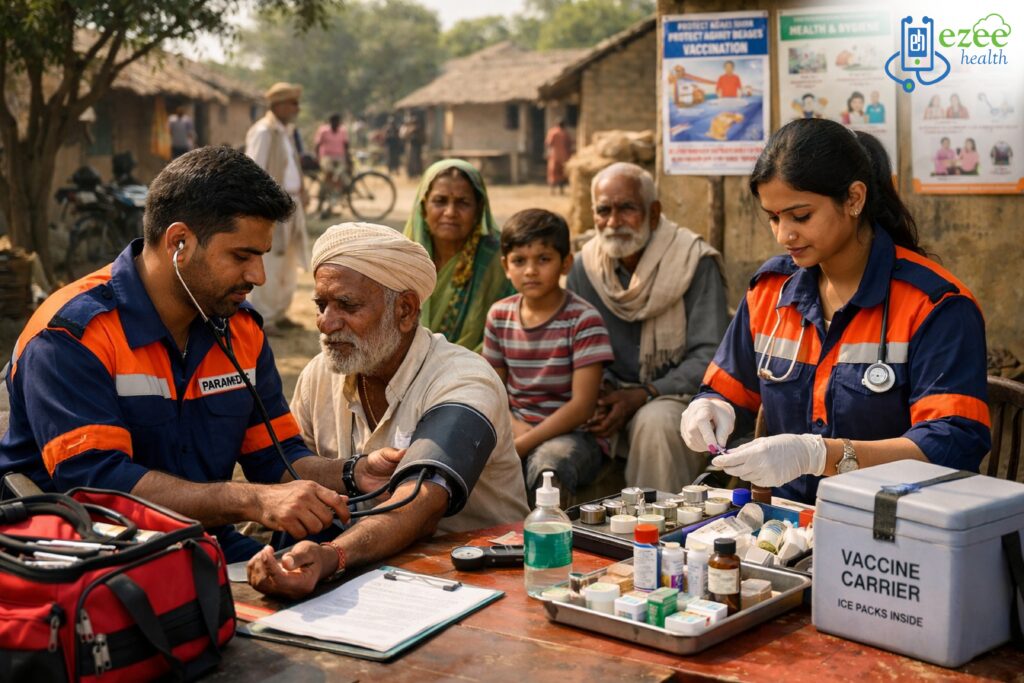
The crucial role of paramedics in delivering healthcare to a larger Indian population​ In India, the first “doctor” most people meet is not an MBBS in a white coat, it is a paramedic who shows up in an ambulance, a health Centre or a village lane when every second actually matters. India’s healthcare story is often told through big hospitals, specialist doctors and high end technology, but the real backbone of access is built by paramedics – the professionals who keep the system running before, beyond and alongside doctors. From accident sites and ambulances to ICUs, labs, radiology units and Health & Wellness Centers, paramedics are the crucial bridge between patients and the formal health system. The World Health Organization has warned of a projected shortfall of around 11 million health workers globally by 2030, with low and lower middle income countries like India most affected. At the same time, India’s own human resources for health data shows that while doctors, nurses and midwives are increasing, the wider allied and paramedical workforce still needs rapid scaling to keep pace with rising demand and universal health coverage goals. In a country with a huge rural and semi urban population, paramedics are not a “nice to have” support function; they are often the only realistic way to deliver timely, affordable care at scale. India’s paramedic gap: a silent emergency Across reports and sector studies, one pattern is clear: India has an acute shortage of trained paramedical professionals. One widely‑quoted estimate suggests the country needs nearly 6.4 million (64 lakh) paramedics to serve the growing health sector, while current trained numbers fall significantly short. This gap shows up as over‑worked hospital teams, long diagnostic delays, and rural facilities where a single nurse or technician is expected to do everything from triage to counselling. Recent health‑workforce profiling shows that while the density of doctors, nurses and midwives has improved over the last decade, the distribution remains uneven and the density of “other key primary health‑care workers” – including community‑based cadres – is still critical for reaching underserved populations. To address physician shortages, India and several states have introduced mid‑level healthcare providers (MLHPs) and community health officers at Health & Wellness Centers, explicitly recognizing that task‑sharing with trained non‑physician cadres is essential. Paramedics, allied health professionals and MLHPs together form the practical backbone that converts health infrastructure into real service coverage, especially for the bottom 80% of the population. What paramedics actually do: from first response to ongoing care Paramedics in India handle a wide range of roles – from emergency medical technicians (EMTs) and ICU technicians to lab, radiology, OT, anesthesia and dialysis technologists, along with community based workers who support public health programmes. They are often the true first responders in emergencies, trained to assess situations, give life saving first aid, perform CPR, manage airways, give specific emergency drugs and stabilize patients during transport. Ambulance and pre‑hospital care show their impact clearly: modern ambulances work like mini ICUs with monitors, oxygen, defibrillators and drugs, but these only save lives when a skilled paramedic is at the bedside using them effectively. In the pre hospital “golden hour” for trauma, stroke or heart attacks, paramedics turn infrastructure into survival through quick decisions, smart use of limited resources and constant updates to hospital teams. Outside emergencies, paramedics run much of the diagnostic engine of healthcare. Lab technicians generate critical test reports, radiology technologists operate imaging equipment, and OT, anesthesia, dialysis and cardiac technicians keep surgeries and chronic‑care services going. In rural and under‑served areas, paramedics also power vaccination drives, maternal and child health programmes, disease surveillance and health education campaigns, massively extending the reach of a limited doctor workforce. How platforms like EzeeHealth unlock the real value of paramedics This is where EzeeHealth fits naturally into the story. While paramedics create capacity on the ground, EzeeHealth lays the digital rails that connect primary, secondary and tertiary care into one smooth, co managed journey for the patient. It works as a next‑generation co‑management platform where the general physician and super specialist share a single digital case sheet, so every referral, report and follow up stays coordinated, not fragmented. In practice, the front line paramedic or primary care team is no longer isolated. An ECG from a small hospital, a CT report from a diagnostic center, or notes from an ambulance or PHC can be shared in real time with higher‑level hospitals, making decisions faster and more accurate, reducing bounced patients, duplicate tests and hidden costs for families, and helping scarce specialists see “worked‑up” cases. For hospitals, EzeeHealth standardizes referrals, information flow, financial settlements and follow up tracking, so paramedics and nurses spend less time chasing calls and paperwork. For patients, it feels like one continuous journey instead of a confusing maze you start with a trusted local doctor or paramedic, and when you need a higher centre, EzeeHealth silently joins the dots so that the hard work paramedics do in saving minutes and lives translates into better outcomes, fairer bills and a more humane experience in moments of crisis. Why does this matter for India’s healthcare future? Paramedics close three big gaps at once: they expand capacity, improve access and make care more efficient. By taking over diagnostics, emergency stabilization, routine procedures and many follow up tasks, they free doctors and nurses to focus on complex decisions and high risk cases. Evidence from India and other countries shows that well trained mid level providers and paramedics can deliver safe, high quality care at lower overall cost, with better rural retention and stronger community trust than a doctor only model. For young Indians, paramedical. education offers a practical, job‑ready route into healthcare beyond MBBS seats, with certificate, diploma, bachelor’s and master’s programmes in areas like emergency care, lab technology, radiology, anesthesia, critical care, dialysis and physiotherapy. As technology evolves – from portable defibrillators and ventilators to telemedicine‑enabled ambulances and co‑management platforms like EzeeHealth – paramedics are being trained to use advanced tools and digital systems, pushing specialist

Scroll to Top